
Best Free Feedback Tools for Startups (2026) - Compared
Honest comparison of free feedback management tools for startups: voting boards, roadmaps, and changelogs. What is free forever vs free trial only.
Building a startup in 2026 means shipping fast and listening even faster. Users share feedback everywhere - emails, Discord, Slack, community posts, in-app messages - and most of it gets lost. What founders actually need is a clear answer to one question: what do our users want us to build next?
That's where feedback boards come in. A good one isn't just a voting wall. It's the foundation for your entire product workflow - collecting requests, prioritizing them, communicating your roadmap, and announcing what you shipped. If you're still evaluating options, our comparison of the best tools for collecting product feedback can help narrow things down.
This guide breaks down the best free feedback management tools for startups and growing SaaS teams. Each tool has genuine strengths and real limitations, so the goal is to help you pick the one that fits where you are right now.
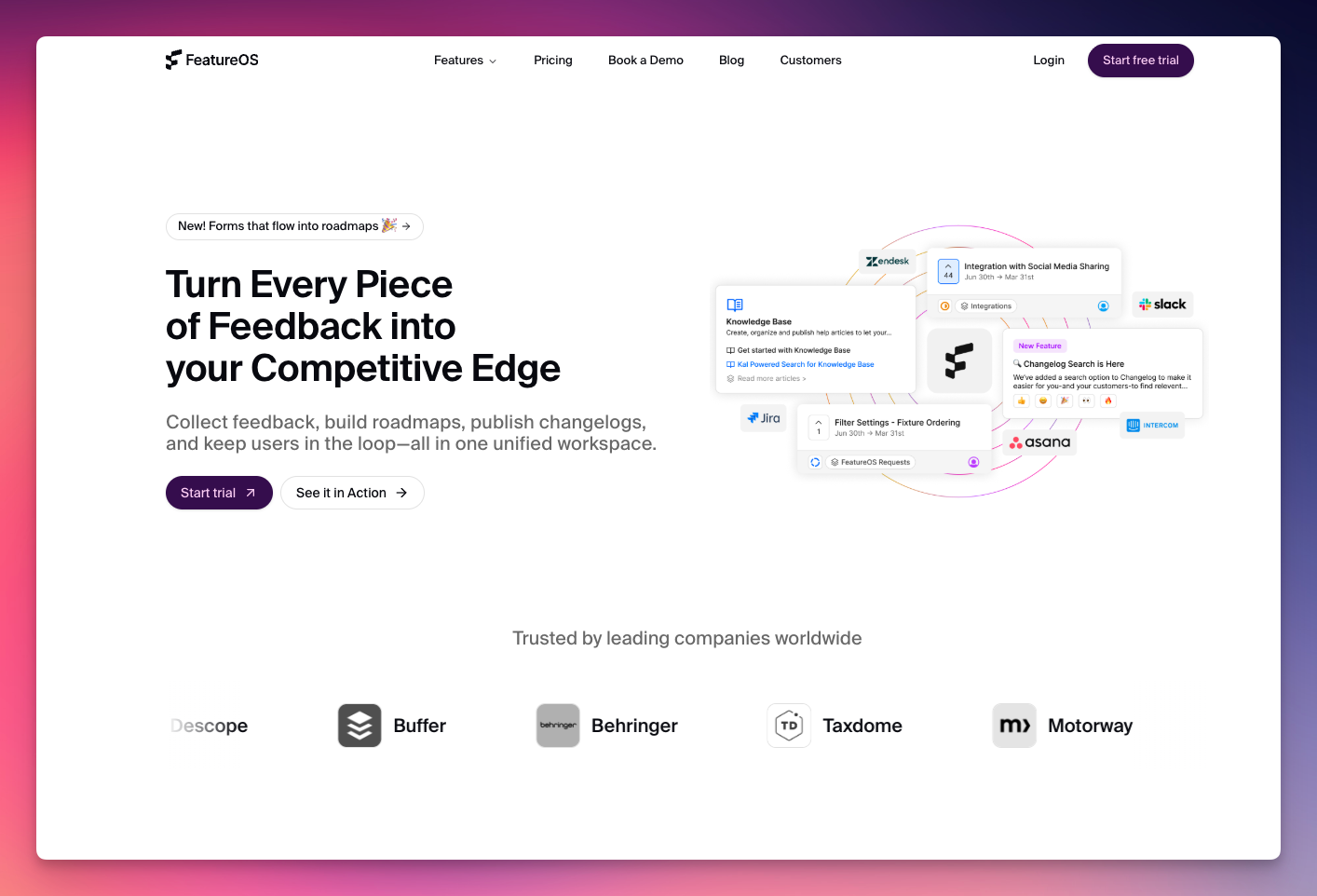
1. FeatureOS
FeatureOS offers a 30-day free trial that gives you full access to all core modules. Unlike tools that strip features behind paywalls, FeatureOS lets you test everything before committing. Paid plans start at $60/month (Starter), making it one of the most affordable full-featured options in this space.
Where most tools limit boards, hide widgets, or cap users, FeatureOS gives early teams enough to run real product operations from day one.
What's included (accessible during the 30-day free trial):
- 5 feedback boards (public or private) for separating user ideas from internal feedback
- Multiple roadmaps for communicating upcoming work across different tracks
- Unlimited users and unlimited feedback - No tracked-user limits or post caps
- In-app feedback widgets to collect feedback directly inside your product
- Users module with organized customer profiles and activity
- Custom domain for a branded feedback portal
- Knowledge base with SEO controls, privacy, multilingual support, and reactions
- Changelog with email notifications - Unlimited posts, scheduled publishing, basic analytics
- Live forms for surveys, bug reports, onboarding feedback, NPS, and CSAT
- Mobile app for managing feedback on the go
Why it stands out: FeatureOS takes a different approach from most feedback tools. Instead of giving you a single board and calling it a day, it pulls together boards, roadmaps, changelog, knowledge base, and forms into one platform. Features like custom domains, multilingual support, widgets, and scheduled publishing are rare even in pricier tools. The result is a system that supports the full cycle: collect input, prioritize, ship, communicate, and learn. The 30-day free trial lets you test all of this before committing.
Best for: Startups that want a feedback foundation they can grow into, not outgrow. Indie makers shipping fast, small SaaS teams that need organization, open-source maintainers, agencies gathering structured input.
Related: The Product Manager's Guide to using FeatureOS Forms
2. Featurebase
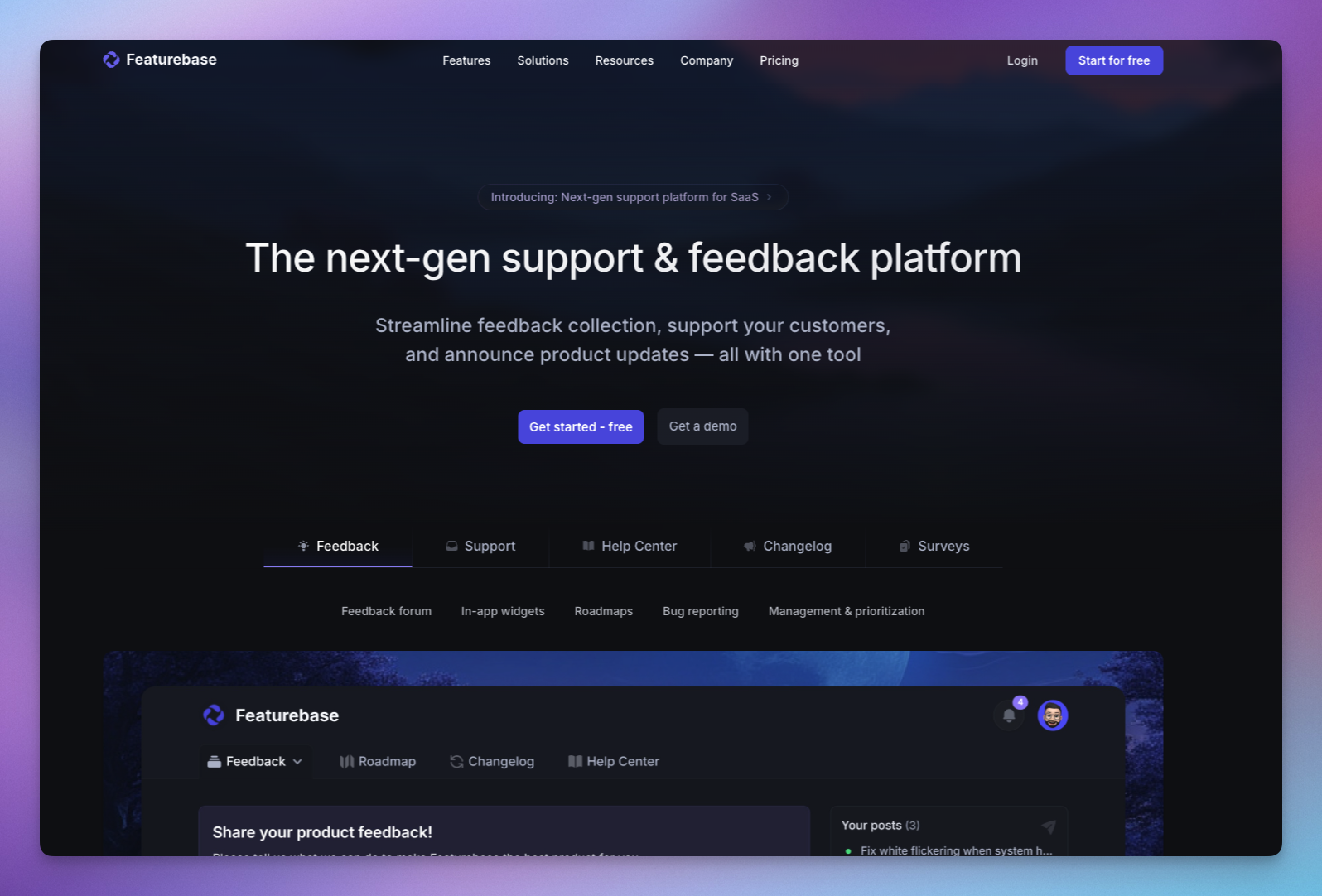
Featurebase offers a lightweight free plan that works for very early projects. The free tier gives you enough to collect basic user suggestions, but it runs into walls once you try to use it for structured product decision-making.
What's included free:
- 1 admin seat for a solo founder or single product owner
- 1 public feedback board - No private or additional boards
- 1 roadmap - Basic, linear view
- Unlimited posts and user interactions - No caps on suggestions, comments, or votes
- Tags, ETAs, and basic notifications
- Multilingual interface - Users can interact in their language
- Live chat and small ticketing module
- Unlimited users and feedback
What's missing: No widgets (can't collect feedback inside your app), no custom domain, no private boards, no moderation tools, no post merging, no custom statuses, no duplicate detection. No segmentation, analytics, or integrations with Discord, Slack, Jira, or Intercom. Knowledge base is capped at 50 articles without SEO or privacy. Changelog limited to 100 emails/month.
In practice, the free plan works as a simple idea bucket rather than a proper feedback management system.
Best for: Hobby projects, early prototypes, and small communities where you just want to gather ideas without deeper workflow needs.
Related: Compare and get a full breakdown of FeatureOS vs Featurebase
3. Canny
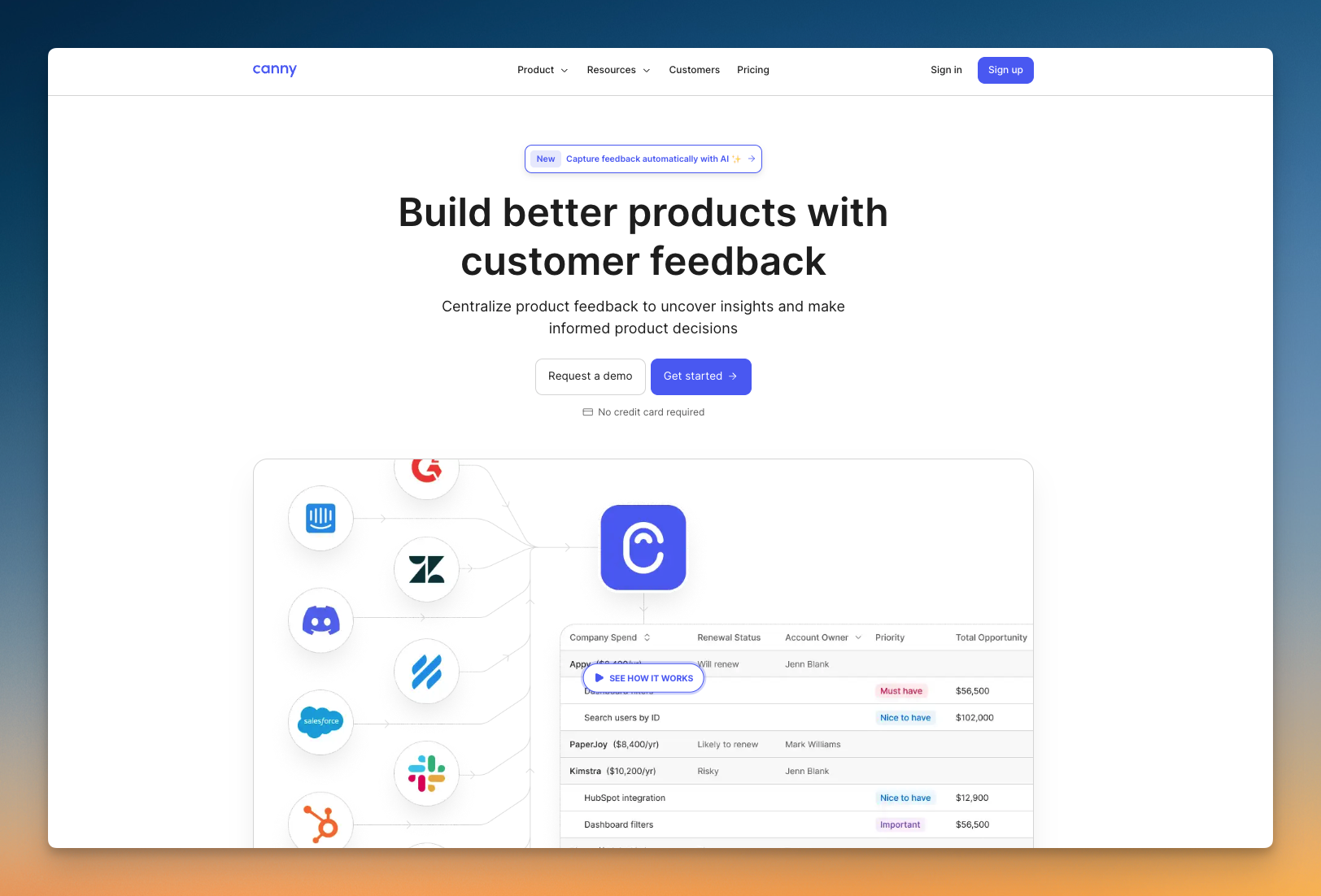
Canny's free plan is polished and thoughtfully designed, with a mature UI and solid feedback workflow features. The catch: it only supports 25 tracked users. For a beta group, that's fine. For anything beyond that, it becomes a forced upgrade.
What's included free:
- Unlimited posts and boards - Flexibility to organize by product line or category
- 5 manager seats - Generous for collaboration
- Core feedback features - Status updates, tags, categories, reports, vote-on-behalf, widget
- Changelog module for publishing updates
- Private boards for internal feedback
- Basic translations for global users
- 1 roadmap
What's missing: The 25 tracked user cap is the defining constraint. Beyond that: no custom domain, no custom statuses, no advanced privacy, no whitelabeling. Roadmap limited to one view. No knowledge base, no forms. Email customization and deeper branding require paid plans.
Best for: Early-stage teams that want a polished feedback experience, don't expect more than 25 users soon, and value structure over flexibility. Also works for small internal teams evaluating feedback processes.
Related: Compare and get a full breakdown of FeatureOS vs Canny
4. UserJot
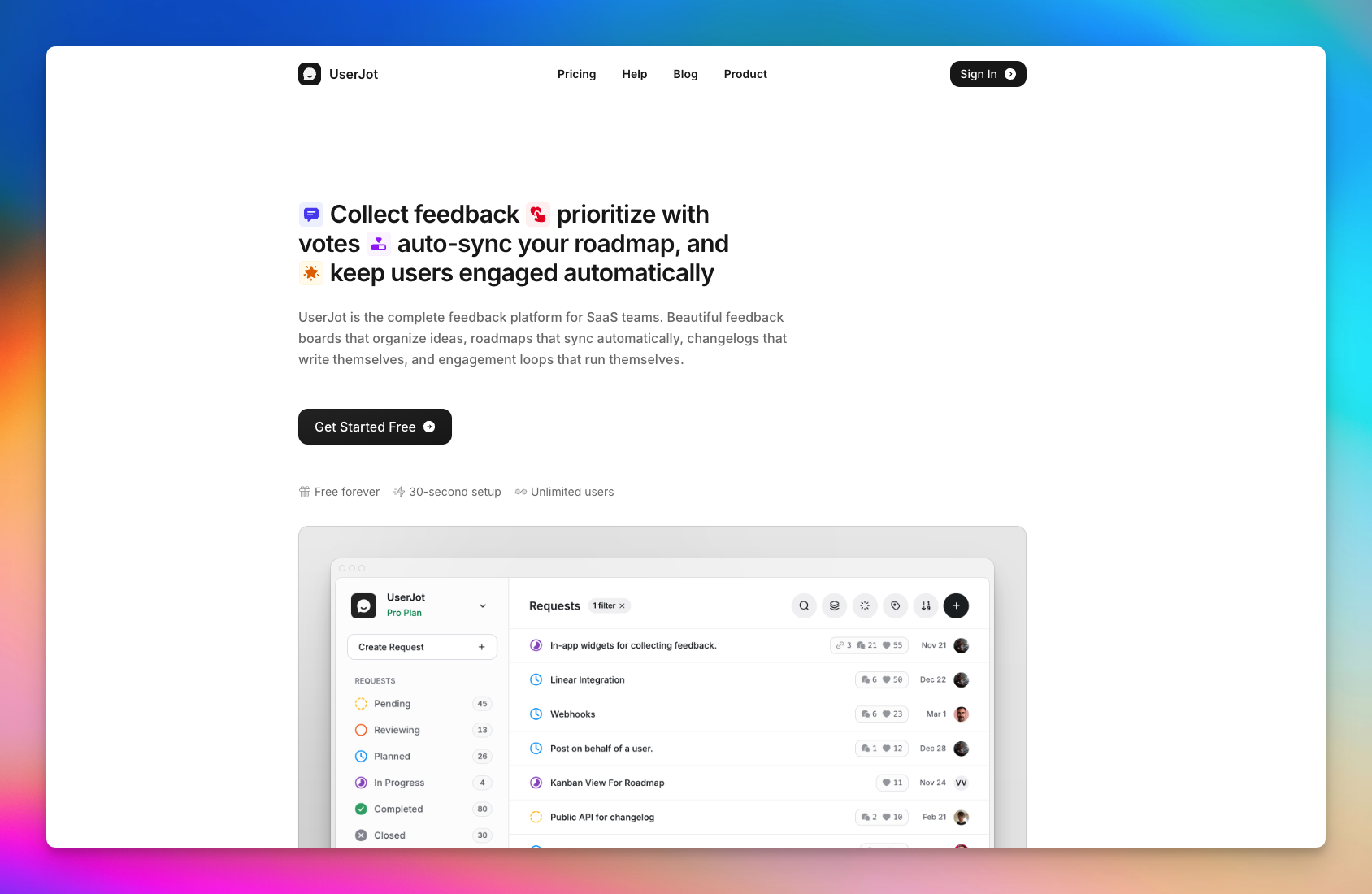
UserJot is straightforward. Clean interface, generous limits on users and posts, and no pressure to upgrade immediately. If you want a simple feedback board without configuration overhead, it's a reasonable starting point.
What's included free:
- Unlimited posts and users - No caps
- 3 admin roles - Enough for a small team
- 2 feedback boards - Separate public from internal feedback
- Basic roadmap - Planned, in progress, completed
- Built-in changelog - Simple update announcements
- Simple, user-friendly interface - No learning curve
What's missing: No custom domain, no guest posting, no private boards, no integrations, no advanced search. No knowledge base, no forms, no prioritization tools. The simplicity is a feature for some teams and a limitation for others.
Best for: Small teams, early projects, and indie founders who want something that "just works" without fussing over configuration. Good starting point, but most growing products will outgrow it.
5. Sleekplan
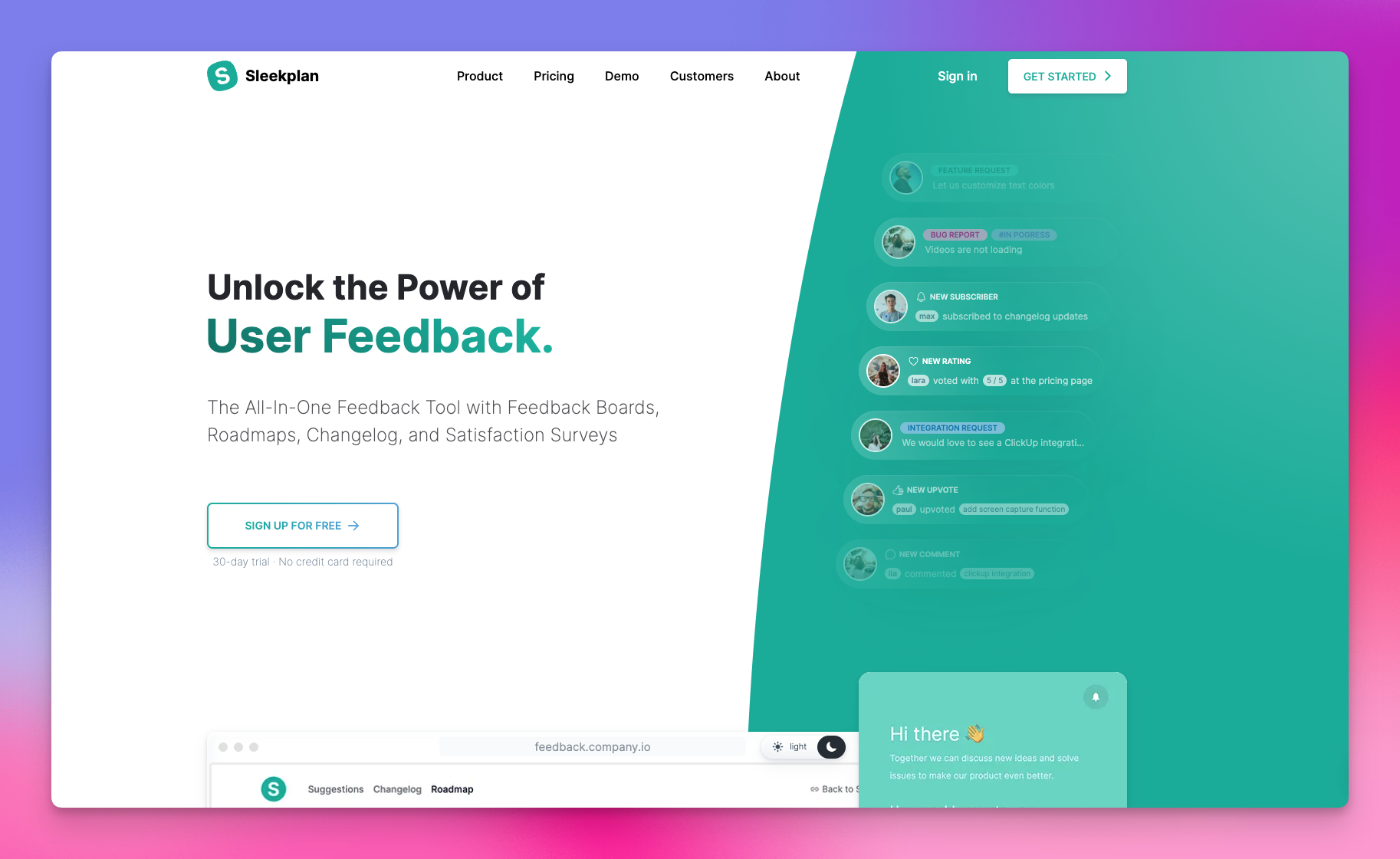
Sleekplan is built for minimalists. If one person is managing feedback and publishing updates, and you don't need complex workflows, it's a clean and friction-free option.
What's included free:
- Unlimited end users, feedback, and subscribers
- 1 team seat - Solo founder or single PM
- Feedback board for ideas, issues, and voting
- Changelog module for publishing updates
- Clean, functional interface - Quick to set up
What's missing: No roadmap, no surveys, no NPS tracking on the free plan. Only one team seat, so collaboration is limited. No integrations or workflow tools on free. Sleekplan is functional but limited - more of a starting point than a long-term tool.
Best for: Solo founders validating early ideas, hobby projects, or side products where you just need to collect feedback and post updates with zero overhead.
Comparison Table
| Feature / Capability | FeatureOS | Canny | Featurebase | UserJot | Sleekplan |
|---|---|---|---|---|---|
| Feedback Boards | 5 boards (public or private)* | Unlimited boards | 1 public board | 2 boards | 1 board |
| Roadmaps | Multiple roadmaps* | 1 roadmap | 1 roadmap | Basic roadmap | Not included |
| Changelog | Unlimited posts + email notifications* | Included | Limited (100 emails/mo) | Included | Included |
| Custom Domain | Included* | Not included | Not included | Not included | Not included |
| Users & Feedback | Unlimited users and feedback | Limited by tracked users | Unlimited | Unlimited | Unlimited |
| Admin Seats | 5 seats (Starter)* | 5 managers | 1 admin | 3 admins | 1 team seat |
| Widgets | Included* | Included | Not included | Not included | Not included |
| Forms / Surveys | Live forms included* | Not included | Not included | Not included | Not included |
| Knowledge Base | KB + SEO + privacy + multilingual* | No KB | 50 articles, no SEO | No KB | No KB |
| Private Boards | Yes* | Yes | No | No | No |
| Translations / Multilingual Support | Full multilingual | Basic translations | Multi-language UI | Not indicated | Not indicated |
| Analytics | Basic analytics provided | Basic admin reports | Not included | Not included | Not included |
| User Module / Profiles | Included | Not included | Not included | Not indicated | Not indicated |
| Mobile App | Included | Not included | Included | Not included | Not included |
| Changelog Scheduling | Included | Not indicated | Not included | Not indicated | Not included |
| Unlimited Subscribers | Yes (via changelog) | Yes | Yes | Yes | Yes |
How to Choose
- Choose FeatureOS if you want a complete foundation - multiple boards, roadmaps, knowledge base, changelog, widgets, forms, and a custom domain, all without user limits. Plans start at $60/month with a 30-day free trial. Best for teams that want one workspace for everything.
- Choose Canny if you want a polished interface with unlimited boards and don't expect to exceed 25 users anytime soon.
- Choose Featurebase if you just need a simple public voting board for a hobby project or early prototype.
- Choose UserJot if you want something lightweight with generous limits but don't need advanced modules.
- Choose Sleekplan if you're a solo founder who wants basic feedback + changelog with zero friction.
Related: How to Turn Customer Feedback into Product Features
FAQ
1. What is a feedback board, and why do startups use one?
A feedback board is a centralized place where users share ideas, report issues, and vote on what they care about. Startups use them to cut through the noise of scattered feedback channels, understand what users actually want, and make product decisions based on real input instead of guesswork.
2. Are free feedback tools actually usable, or do they force upgrades quickly?
Most free plans in this category are restrictive - single board, no widgets, no custom domain, low email caps. That's why it matters which one you choose. Tools like UserJot have more functional free tiers, while others feel more like limited trials. FeatureOS takes a different approach with a generous 30-day free trial and affordable paid plans starting at $60/month.
3. Which free feedback tool is best for early-stage startups?
FeatureOS, because it doesn't cap users or hide core modules behind paywalls. You get multiple boards, roadmaps, a knowledge base, full changelog, widgets, forms, and a custom domain. The 30-day free trial lets you test everything, and the Starter plan at $60/month is affordable for early teams.
4. What's the difference between a feedback board and a roadmap?
A feedback board collects ideas and votes from users. A roadmap communicates what your team plans to build next. They work best together: feedback shapes the roadmap, and the roadmap shows users how their input influences the product.
5. Can I use a free feedback tool with unlimited users?
Featurebase, UserJot, and Sleekplan allow unlimited users on their free plans. Canny limits you to 25 tracked users. FeatureOS also supports unlimited users on all paid plans (starting at $60/month) and during the 30-day free trial.
6. Do free feedback tools include in-app widgets?
Not all of them. Canny includes widgets on its free plan. FeatureOS includes widgets on all paid plans and during the 30-day free trial. Featurebase, UserJot, and Sleekplan typically require upgrades for in-app collection.
7. Which tool is best if I need a built-in knowledge base?
FeatureOS is the only tool here that includes a full knowledge base on all paid plans (starting at $60/month), with SEO controls, multilingual support, privacy settings, and article reactions. You can test it during the 30-day free trial.
8. Do any free feedback tools support private boards?
Canny supports private boards on its free plan. FeatureOS includes private boards on all paid plans and during the 30-day free trial. Featurebase, UserJot, and Sleekplan limit you to public boards only.