
9 Best Customer Feedback Management Tools in 2026
A practical guide to the best customer feedback management tools for product teams. Compare features, pricing, and trade-offs to find the right fit for your workflow.
I have been building product tools for over a decade now. And one pattern keeps showing up: teams don't struggle with collecting feedback. They drown in it.
Feature requests pile up in Intercom. Bug reports get lost in Slack. A sales rep mentions that three enterprise prospects want the same thing, but nobody tracks it. Six months later, the PM builds something nobody asked for because the real signal got buried under noise.
That is the problem a feedback management tool is supposed to solve. Not just collecting votes on a board, but creating a system where feedback flows into product decisions, and customers actually see the impact of their input. The best tools handle the full loop - capture, prioritize, ship, and tell customers about it - in one place.
I have tested and used dozens of these tools over the years. Some are great at one thing. Others try to do everything. A few are genuinely overpriced for what they deliver. This guide breaks down nine tools I think are worth your time in 2026, and I have tried to be honest about where each one falls short - including the tool I built myself.
If you are interested in broader product tooling, we have also put together a comparison of the best tools for collecting product feedback. And if you are specifically looking for an alternative to your current tool, our alternatives hub has head-to-head comparisons.
How We Evaluated These Tools
Five things matter when picking a feedback management tool. Everything else is nice-to-have.
1. Centralized intake - Can the tool pull feedback from your support inbox, CRM, Slack, and in-app interactions into one place? If your team still needs to copy-paste feature requests from Zendesk into a spreadsheet, the tool is failing you.
2. Prioritization that scales - Voting is a starting point, not a strategy. You need to weigh requests against customer revenue, segment data, and your product goals. The tools that let you do this well are the ones worth paying for.
3. Customer context - A request from your $50/month hobbyist and a request from your $5,000/month enterprise account should not carry the same weight. Your tool should show you who is asking, not just what they are asking for.
4. Workflow integration - If feedback lives in one place and your roadmap lives somewhere else, the link between them breaks. Good tools plug into Jira, Linear, or whatever your engineering team actually uses.
5. Closing the loop - This is the part most teams skip. When you ship a feature someone asked for, they should know about it. Changelogs, status updates, and roadmap visibility are not optional if you care about retention.
The 9 Best Customer Feedback Management Tools
1. FeatureOS (Best Overall)
I built FeatureOS, so you should know that upfront. But the reason it tops this list is not bias - it is the only tool here that covers the entire feedback lifecycle without charging you more as your user base grows.
Most feedback tools make you choose: you get a voting board OR a roadmap OR a changelog. Then you stitch three different products together and hope they talk to each other. We built FeatureOS to eliminate that compromise. It runs on a single workflow - Capture, Plan, Ship - where feedback, roadmapping, and release communication live in the same workspace.
The feedback boards support public and private use cases. Votes, comments, status updates - the basics you would expect. What saves real time is the duplicate merging and auto-categorization that runs in the background. When you are handling hundreds of requests a month, not having to manually tag and deduplicate everything adds up fast.
But the thing I hear from customers most often is: "I did not expect to get all of this in one tool." We include multiple roadmaps (not just one view), a full changelog with scheduled publishing and email notifications, a knowledge base with SEO controls and multilingual support, and custom forms for surveys, NPS, CSAT, and bug reports. There are also in-app widgets for collecting feedback right inside your product.
And none of it is locked behind tracked-user limits. That is the pricing model I have a problem with (more on that when we get to Canny).
What you get:
- Public and private feedback boards with voting, comments, and duplicate merging
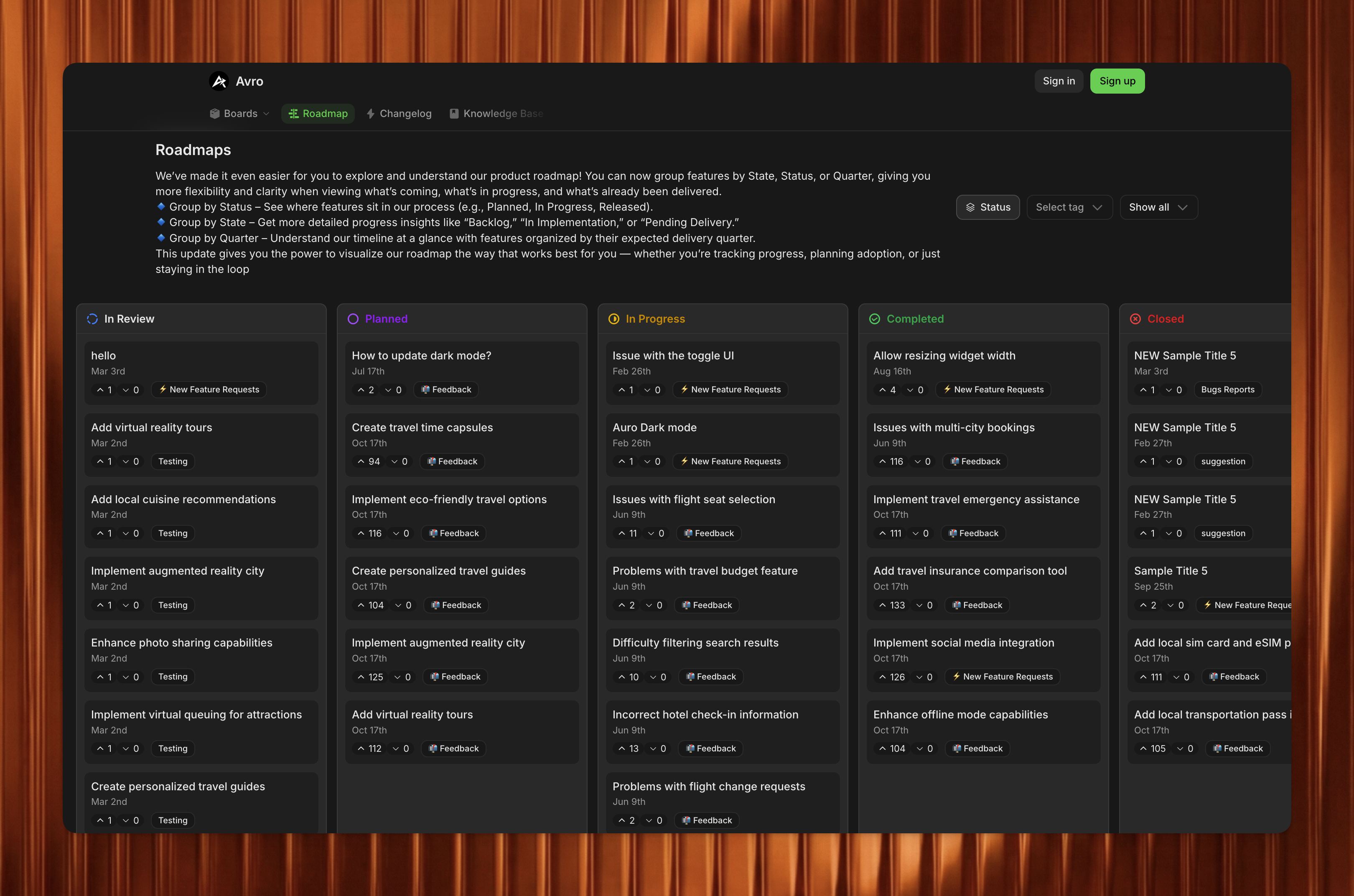
- Multiple roadmaps with drag-and-drop prioritization and RICE scoring
- Changelog with scheduled publishing and email notifications
- Knowledge base with multilingual support and SEO controls
- Custom forms for surveys, NPS, CSAT, and bug reports
- In-app widgets for contextual feedback collection
- Native integrations with Jira, Linear, Slack, Intercom, and more
- Custom domain and white-labeling on all plans
Pricing: Paid plans start at $60/month with a 30-day free trial. No tracked-user pricing, ever. Every plan includes feedback boards, roadmaps, changelog, knowledge base, widgets, and forms. If you are coming from another tool, we handle the migration for you.
Where it falls short: FeatureOS is not built for teams that need a pure analytics engine for mining unstructured feedback across dozens of data sources. If you have thousands of support tickets a day and need automated theme detection, Enterpret (further down the list) is designed for that - though you would still need FeatureOS or something like it to actually collect and act on the feedback.
2. Canny
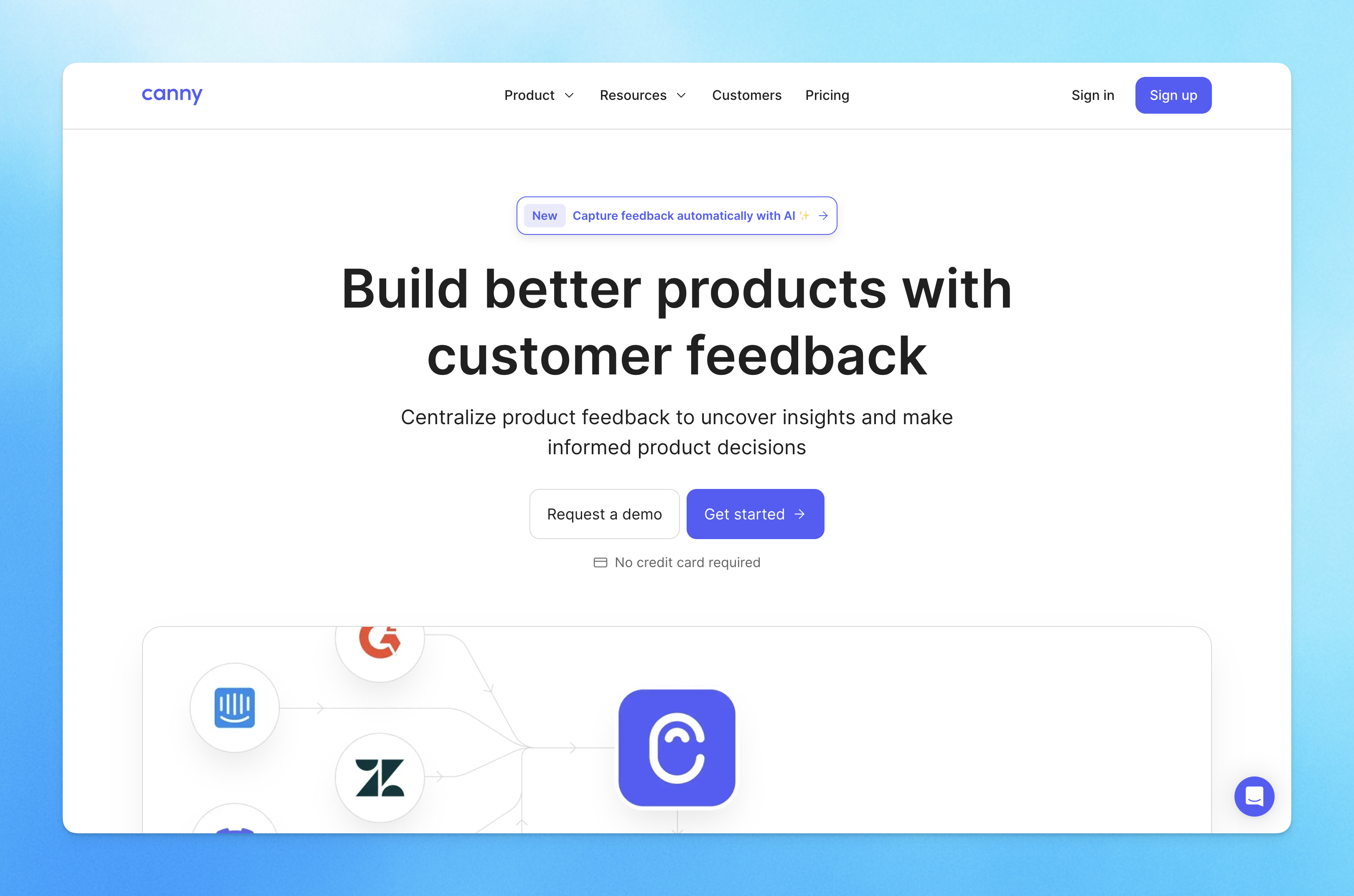
Canny is probably the first name that comes up when people Google "feedback management tool." The product is polished, the UI is clean, and the feedback boards work exactly the way you would expect them to.
Their Autopilot feature is worth calling out - it connects to tools like Intercom and Zendesk and automatically pulls feedback into Canny without your team doing anything. For support-heavy teams, that can save hours of manual work every week. They also have decent CRM integrations with HubSpot and Salesforce, and they take compliance seriously (GDPR, CCPA, SOC 2 Type 2).
Now, the pricing conversation. Canny uses a tracked-user model. That means every person who submits feedback, votes, or comments on your board counts toward your bill. Their free plan caps at 25 tracked users. Paid plans start at $19/month (Core) and go up to $79/month (Pro), both billed yearly, scaling with tracked users.
This creates a weird incentive: the more people engage with your feedback board, the more you pay. For a startup growing fast, that math gets uncomfortable quickly. We have written about this in detail - here is our deep dive on Canny's pricing model.
What you get:
- Public and custom-access feedback boards with voting
- Autopilot for automatic feedback capture from support tools
- Customer segmentation by plan type, ARR, or lifecycle stage
- Roadmap and changelog modules
- CRM integrations with HubSpot and Salesforce
Pricing: Free plan with 25 tracked users and 5 admin seats. Core from $19/month, Pro from $79/month (billed yearly). Business is custom.
Where it falls short: The tracked-user pricing is a hard sell for growing products. One roadmap on lower tiers. No knowledge base. No forms. No in-app widgets on lower plans. For the same price as Canny Pro, you get significantly more functionality with FeatureOS - including features Canny does not offer at any price. We have a side-by-side comparison page that covers the differences in detail.
3. UserVoice
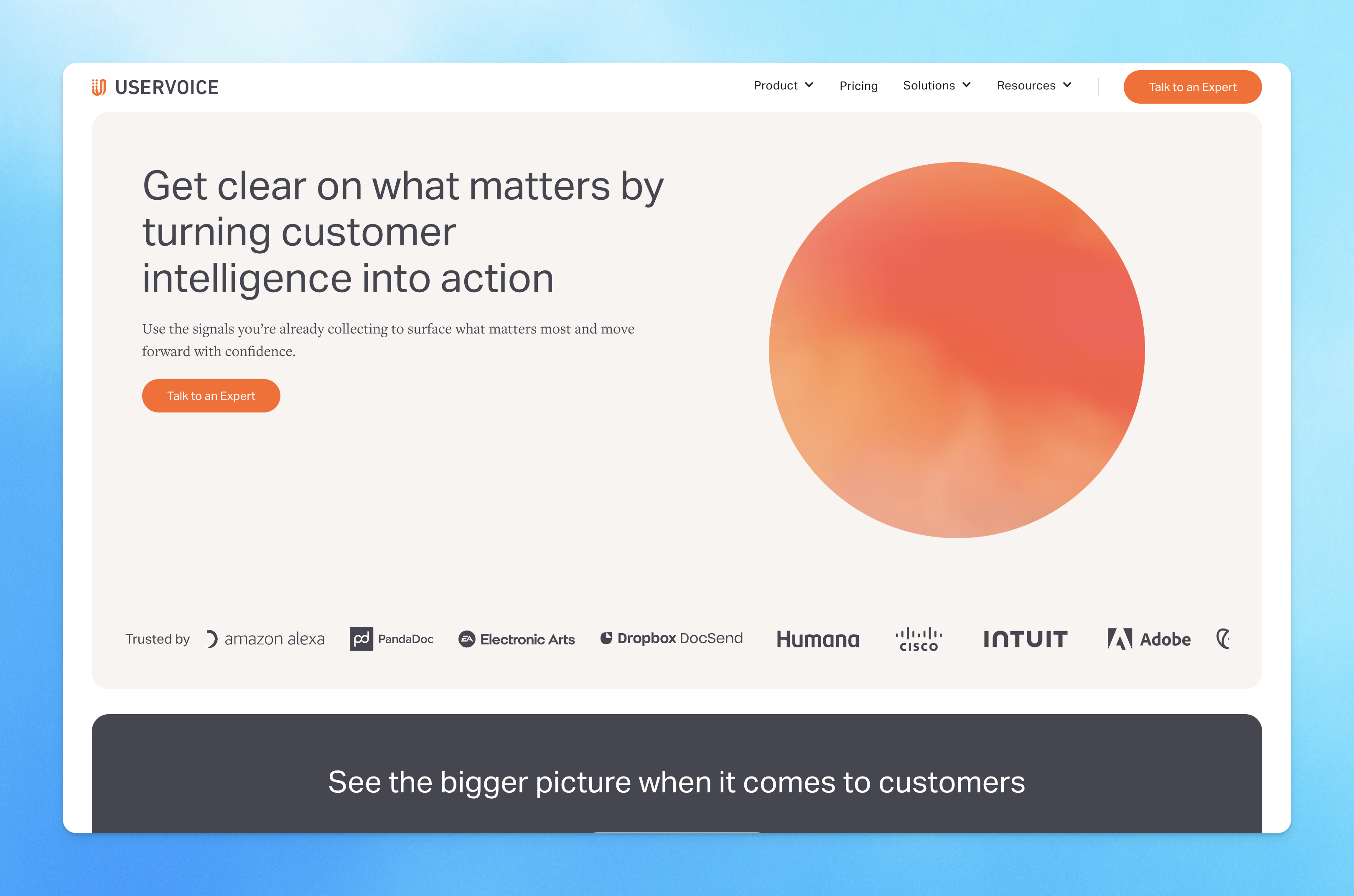
UserVoice is the old guard. They have been doing this since before most of the tools on this list existed, and they built their product specifically for enterprise organizations with complex internal processes.
If your company has formal product governance - think approval stages, role-based permissions, multiple review committees before a feature gets greenlit - UserVoice is designed for that. The platform includes structured internal review workflows, enterprise-grade security controls, and branded feedback portals that can be public or private.
They have also added AI-assisted summaries and analysis, plus a built-in knowledge base for support deflection. The CRM integrations provide customer context alongside feedback, which is useful when you need to connect requests to account value.
The downsides are real, though. The interface has not aged well. Setup takes time. And the pricing starts at $16,000/year with no free tier and no self-serve option - everything goes through sales. If you are a 10-person startup, this is not for you. Most teams that look at UserVoice end up realizing they can get 80% of the value from a tool like FeatureOS at a fraction of the cost.
Pricing: Starts at $16,000/year. Sales-led.
Good fit for: Enterprise teams with formal governance, strict security requirements, and budget to match. Not for: Anyone who wants to get started this week.
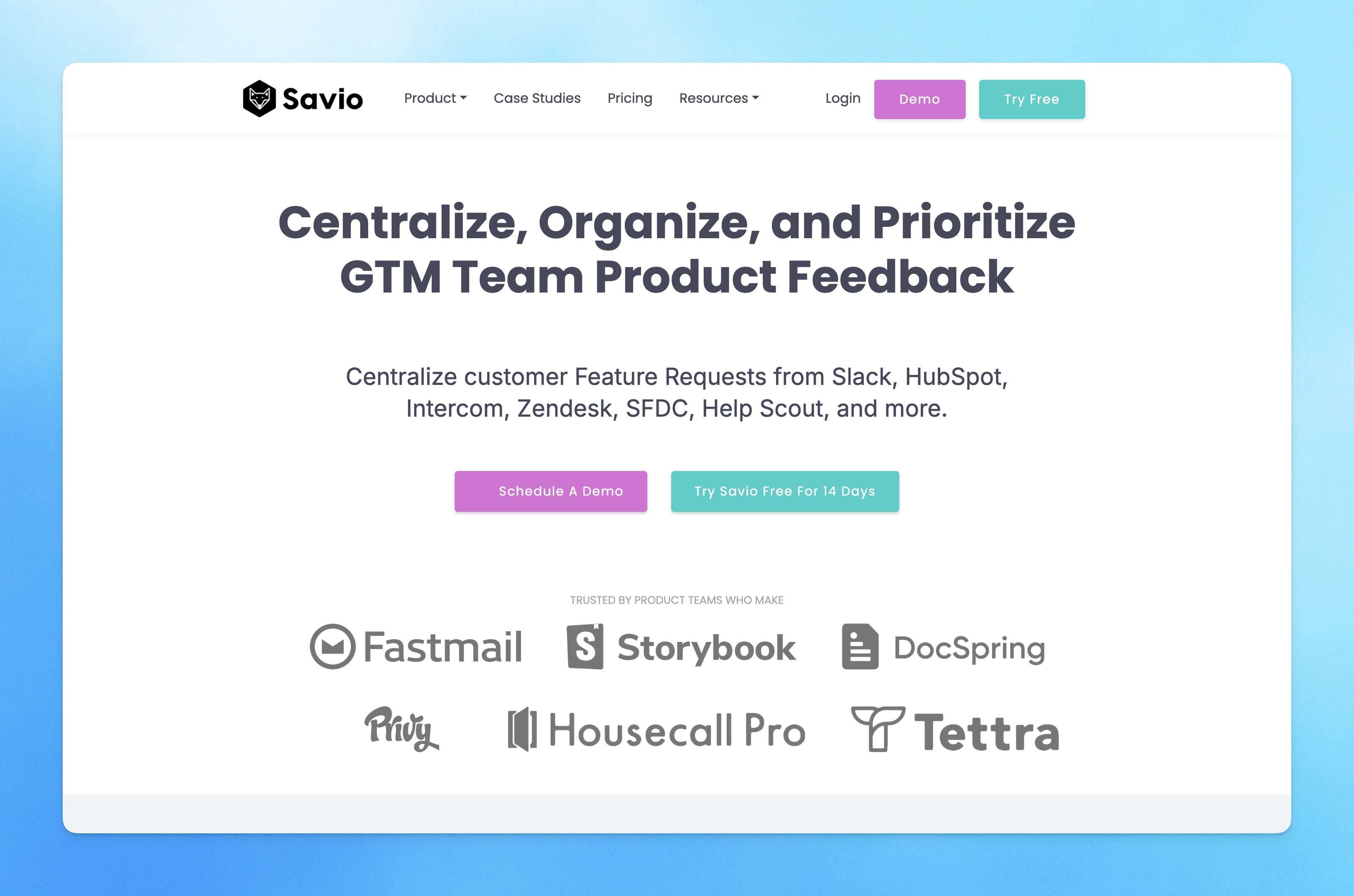
4. Savio
Savio carved out a smart niche. If your product feedback mostly comes through support conversations - Intercom chats, Zendesk tickets, Help Scout emails - Savio makes it dead simple to tag requests inside those tools and funnel them into a centralized view.
The support team tags a feature request right inside the Intercom conversation. It shows up in Savio. The PM sees it alongside every other request, with customer data attached. No context switching, no manual entry. That workflow alone is why teams pick Savio over more feature-rich alternatives.
On higher tiers, you get CRM integration that lets you prioritize by customer revenue. That means you can filter your backlog to see "what are our $10K+ accounts asking for?" which is a genuinely useful lens for prioritization.
The limitation is scope. Savio does not have a changelog. The public board is basic compared to dedicated feedback tools. And the per-user pricing on advanced tiers can get expensive if your product team is growing.
Pricing: Starts at $39/month (one paid user). Mid tier at $79/month, top tier at $249/month. Additional users extra on each plan.
Good fit for: Support-driven teams that live in Intercom or Zendesk and want revenue-weighted prioritization. Not for: Teams that need a public feedback portal, changelog, or knowledge base alongside their feedback boards. If you need both the support-driven intake and the customer-facing experience, FeatureOS covers both without needing a second tool.
For more context, we have a detailed comparison: FeatureOS vs Savio.
5. Productboard
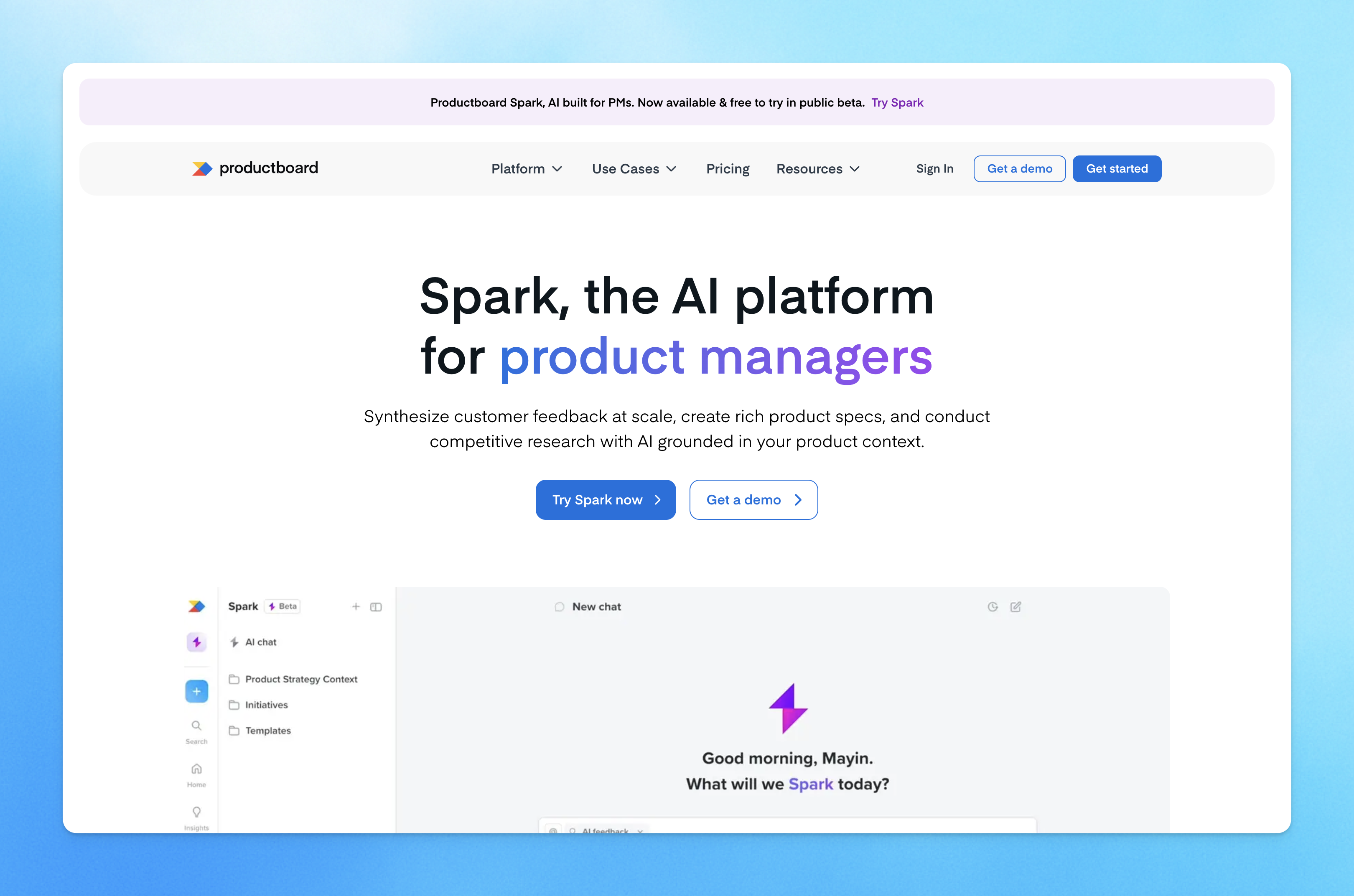
Productboard sits in a different category from the other tools here. It is less "feedback tool" and more "product management platform that includes feedback collection." If you are a PM who thinks in terms of objectives, key results, and feature scoring matrices, Productboard speaks your language.
The insights repository pulls in feedback from various sources. The real power is linking those insights to features and objectives, then using custom scoring formulas to prioritize your roadmap. On the Pro plan, you can build scoring models that factor in strategic fit, customer demand, and effort - similar to a RICE framework but more customizable.
Productboard Spark adds AI-powered analysis, though it is sold separately from the main platform.
Here is the friction: there is a genuine learning curve. Productboard is complex, and smaller teams often find themselves spending more time configuring the tool than actually using the insights. The per-maker pricing also adds up - at $75/maker/month on Pro (minimum 2 makers), a 5-person product team is paying $375/month before anyone submits a single piece of feedback. For context, that is more than six times what FeatureOS costs for unlimited team members.
Pricing: Productboard Spark (their AI product agent) starts at $15/maker/month billed annually, or $19 monthly. The legacy Platform plans run Essentials at $25/maker/month and Pro at $75/maker/month (minimum 2 makers). Enterprise is custom.
Good fit for: Product teams that want a full product management suite with feedback built in, and have the bandwidth to learn and maintain it. Not for: Teams that just want a clean way to collect and prioritize user feedback without the overhead. See our Productboard pricing breakdown for the full cost picture.
6. Frill
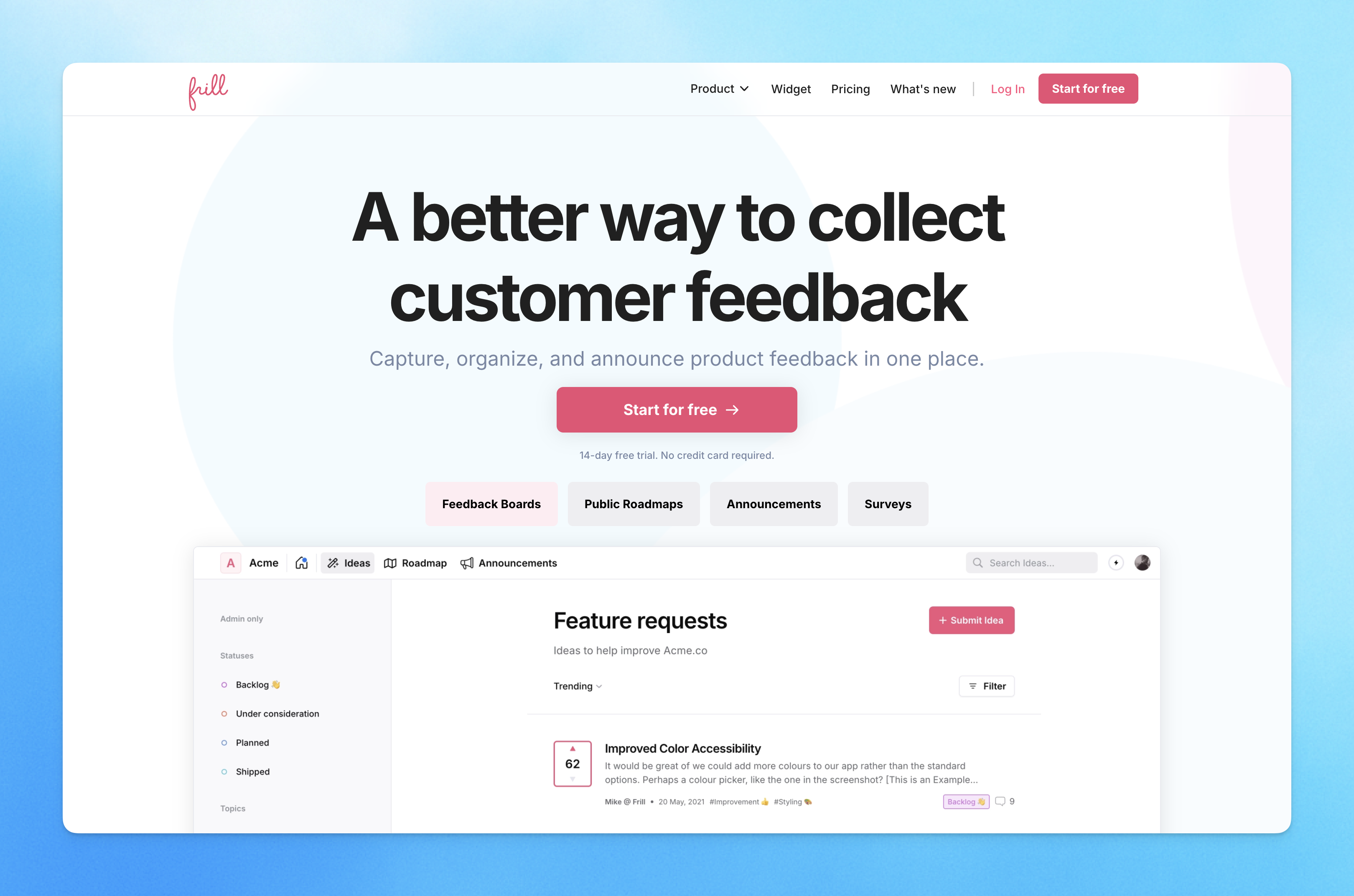
Frill is the feedback tool equivalent of a well-organized notebook. It does not try to do everything, and that is actually its strength for small teams.
You get a public voting board, a roadmap view, a changelog, and built-in surveys. Setup takes about ten minutes. The interface is clean. Pricing is transparent and predictable. For a startup that just needs somewhere to collect ideas and show users what is coming next, Frill works without getting in your way.
What you will not find: customer segmentation, CRM integration, automated feedback capture, or duplicate detection. Prioritization is manual - you sort things yourself and update statuses by hand. That works fine when you are getting 20 requests a month. When you hit 200, you will probably outgrow it and want something like FeatureOS that handles deduplication and categorization automatically.
The built-in survey feature is a nice differentiator, though. Most feedback tools treat surveys as a separate product. Frill includes them alongside your boards, which means you can run an NPS survey and collect feature requests in the same platform.
Pricing: Startup at $25/month (50 ideas, one survey). Business at $49/month (unlimited). Growth at $149/month.
Good fit for: Early-stage startups that want a fast, clean setup with surveys included. Not for: Teams that need automated feedback processing or CRM-based prioritization.
For a broader comparison of tools in this price range, check out our guide to the best free feedback management tools for startups.
7. Nolt
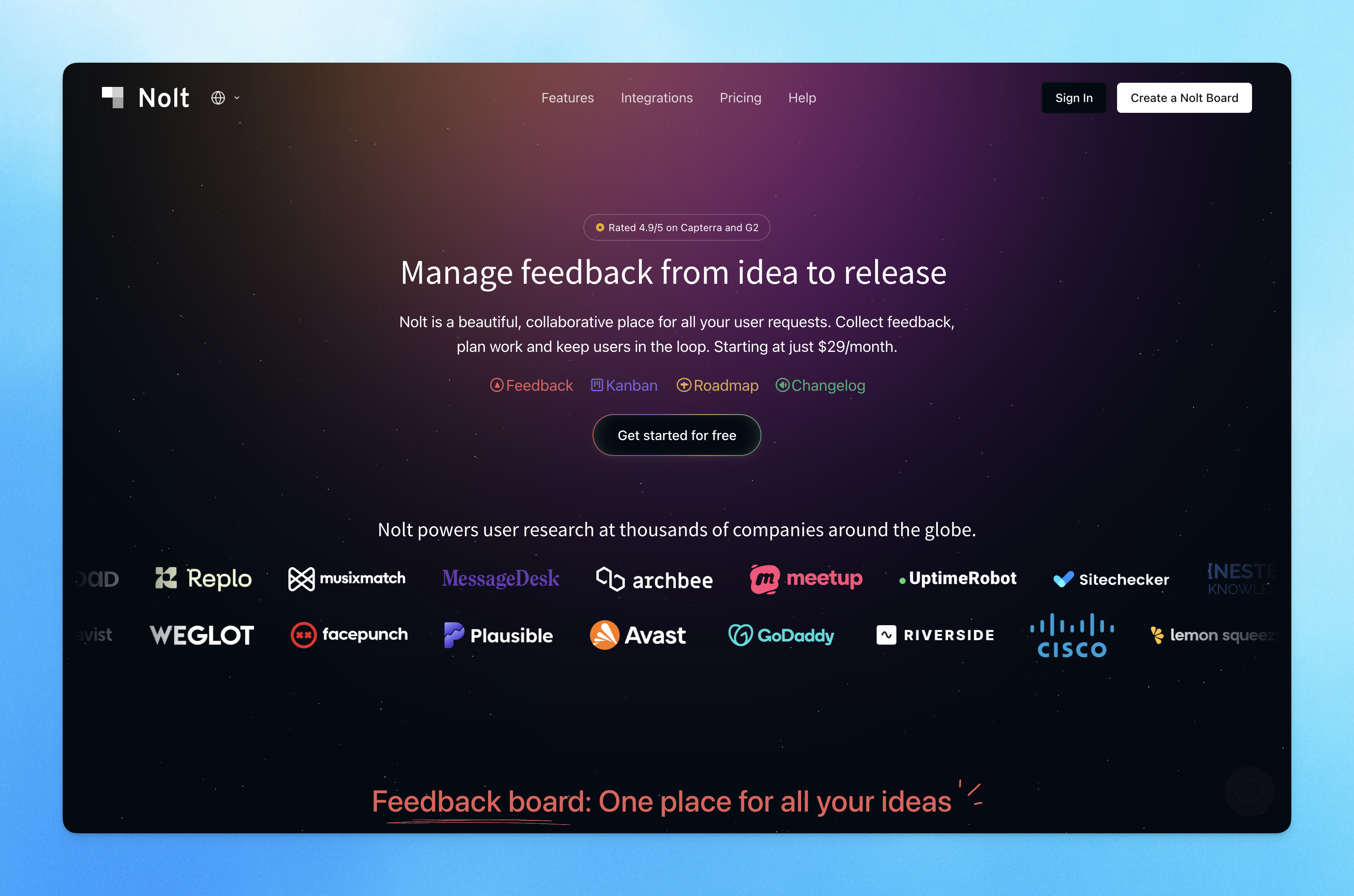
Nolt has a pricing model I genuinely appreciate: you pay per board, not per user. $39/month gets you one board. $89/month gets you five. Everyone on your team, and every single user, gets unlimited access at no extra cost.
The product itself is straightforward. Feedback boards with voting, a roadmap view, proxy voting (so your support team can submit on behalf of customers), custom statuses, and basic duplicate detection. It integrates with Slack, Intercom, Jira, Linear, GitHub, Trello, and a few others.
Nolt works best when you want one or two focused feedback boards and you do not need much beyond that. There is no CRM integration, no revenue-based prioritization, and notably, no changelog. So you collect the feedback, but closing the loop with customers when you ship something requires a separate tool. That is the gap that made us build FeatureOS as a single platform - feedback without follow-through is just a suggestion box.
Pricing: Essential at $39/month (one board). Pro at $89/month (five boards). Enterprise is custom.
Good fit for: Teams that value predictable pricing and just need clean feedback boards without the bells and whistles. Not for: Teams that want an end-to-end system with roadmaps, changelog, and customer communication.
8. Upvoty
Upvoty occupies a similar space as Frill and Nolt but puts more emphasis on the customer-facing experience. The voting boards, roadmap, and changelog are all designed with end-user transparency in mind - your customers can see exactly what is being considered, what is in progress, and what shipped.
One feature that stands out: leaderboards. It is a gamified ranking of your most active feedback contributors. For community-driven products (open source tools, gaming communities, creator platforms), that kind of engagement mechanic can meaningfully increase participation.
Customer segmentation is included, which is more than some lightweight tools offer. The integrations cover Slack, Jira, Intercom, and Zapier, which handles most common workflows.
Where Upvoty feels thin is on the backend. No CRM integration for revenue data. No automated feedback capture. No duplicate detection or merging. You are doing the organizational work manually, which is fine for smaller volumes but gets tedious as you scale.
Pricing: Power at $25/month. Super at $49/month. Hyper at $99/month.
Good fit for: Community-driven products that want a transparent, engaging feedback experience for their users. Not for: B2B SaaS teams that need revenue-based prioritization or automated intake. For a deeper comparison, see our Upvoty alternatives guide.

9. Enterpret
Enterpret does not belong in the same category as the other eight tools on this list, and that is exactly why it is here.
Every other tool I have covered is fundamentally a place to collect and organize feedback. Enterpret is a feedback analytics engine. It connects to your support tickets, surveys, app reviews, social media mentions, and sales call transcripts, then automatically clusters themes, tracks sentiment, and surfaces trends across all of it.
No manual tagging. No taxonomy you have to maintain. The system figures out what your customers are talking about and shows you patterns over time. You can filter by revenue data from your CRM to see what your most valuable customers care about versus your free tier. For teams processing thousands of feedback signals a day across fragmented sources, that kind of automated analysis is genuinely valuable.
The catch: Enterpret has no customer-facing boards. No roadmap. No changelog. It is purely an internal analysis tool. You still need something else (like FeatureOS) to collect structured feedback, communicate your roadmap, and close the loop with customers. And the pricing reflects the enterprise positioning - reported median contracts run around $36,000/year.
Pricing: Not listed publicly. Sales-led, reported around $36,000/year.
Good fit for: Large teams with high feedback volume across many channels that need automated analysis and cross-functional dashboards. Not for: Anyone who needs customer-facing boards, or anyone on a startup budget.
Comparison Table: Customer Feedback Management Tools at a Glance
How to Pick the Right Tool for Your Team
Here is how I would think about it:
For most teams, FeatureOS is the best starting point. It is the only tool on this list that covers feedback boards, roadmaps, changelog, knowledge base, and forms in a single platform - with a 30-day free trial and no tracked-user pricing to surprise you later. Whether you are a 5-person startup or a 50-person product org, the same tool scales with you without the bill scaling faster.
That said, there are specific scenarios where a different tool makes more sense:
You run a large organization with formal review processes and strict security requirements. Look at UserVoice for structured governance, or Enterpret if your main challenge is making sense of high-volume unstructured feedback. (Though even Enterpret users typically pair it with a tool like FeatureOS for the customer-facing side.)
Your feedback comes through support conversations, and you want to prioritize by customer revenue. Savio is purpose-built for that workflow, though it lacks the roadmap and changelog you will eventually need.
You want a product management suite that includes feedback as one module alongside objectives, scoring, and strategic planning. Productboard goes deeper on product strategy than anyone else here - if you have the budget and the team to maintain it.
You want something simple, fast, and cheap. Frill if you want surveys included. Nolt if you like per-board pricing. Upvoty if transparency and community engagement matter most. Just know that these lightweight tools tend to become the thing you replace within a year as your needs grow.
You are currently on Canny, Featurebase, or another feedback tool and the pricing or feature gaps are getting painful. We have heard from a lot of teams in that position. Check out our FeatureOS vs Canny comparison or our FeatureOS vs Featurebase comparison to see what you would gain by switching.
The worst thing you can do is pick a tool based on a feature list for a problem you do not have yet. Start with what you need today. But if I had to recommend one tool that grows with you from day one to day one thousand - it is FeatureOS. Start your free trial and see for yourself.
Related Reading
- 15 Best Customer Feedback Examples from Top Brands - See how Amazon, Netflix, Slack, and others collect and act on customer feedback.
- Canny Pricing 2026: Hidden Costs Explained - Why tracked-user pricing gets expensive fast, with real cost comparisons.
- What is Product Service Management? - How PSM teams align product services with customer needs through feedback loops.
Frequently Asked Questions
Everything you need to know
It is the process of collecting, organizing, and acting on what your users tell you. Feature requests, bug reports, survey responses, support conversations - all of it. Instead of letting feedback scatter across Slack, email, and support tickets, you bring it into one place and use it to make better product decisions.
Surveys ask specific questions at specific moments - like an NPS score after onboarding. Feedback management tools handle the ongoing, unsolicited stuff: feature requests, ideas, complaints, suggestions. They organize it over time so you can spot patterns and prioritize. Some tools like FeatureOS and Frill include survey features alongside their feedback boards, but the core job is different.
You can start with a spreadsheet. Plenty of teams do. It works until it does not - usually around the time feedback starts coming from more than two or three channels. Duplicates pile up, you lose track of who asked for what, and there is no good way to tell customers when you ship their request. A dedicated tool becomes worth it once the spreadsheet starts costing you more time than it saves.
Some tools charge based on how many people interact with your feedback boards. Every user who votes, comments, or submits a request counts toward your bill. That means your costs grow with your user base, which gets unpredictable fast. Tools like FeatureOS, Nolt, and Upvoty use flat or board-based pricing instead - your bill stays the same whether 100 or 10,000 people use your boards.
Most tools support data export in some form. The important questions: can you get your feedback data out in a usable format, and does the new tool support importing it? If you are coming from Canny or another platform, FeatureOS handles the full migration for you - we move your data, boards, and voter history over so you do not have to.
Depends on what you need. If you want the most complete package - boards, roadmaps, changelog, knowledge base, forms, and widgets without user limits - FeatureOS covers the most ground with plans starting at $60/month and a 30-day free trial. Frill and Nolt are solid lightweight options if you need less. I would avoid enterprise tools like UserVoice or Enterpret unless your feedback volume and budget genuinely justify the price tag.