
10 Best ProdPad Alternatives in 2026 (Features, Pricing, and Trade-offs)
ProdPad's modular pricing adds up fast. Compare 10 ProdPad alternatives with honest feature breakdowns, real pricing, and clear recommendations for every team size.
I've spent the last decade building product tools. ProdPad is one I respect - they invented the Now-Next-Later roadmap, and Janna Bastow has done more for the product management community than most people realize. But respect doesn't mean it's the right tool for every team.
ProdPad charges per module, per editor. You want roadmaps, idea management, and feedback collection - which is the whole point - you're paying for three separate modules. A single editor using all three modules pays $116/month (billed annually). A 5-person product team? $580/month. That's nearly $7,000 a year before you even count add-ons.
That math is what pushes teams to look for alternatives. And having tested most of them over the years, I can tell you: there are tools that give you more for significantly less. Some are better at specific things. A few are overpriced themselves. This guide covers ten alternatives worth considering, with honest assessments of where each one shines and where it falls short.
If you want a direct head-to-head, we also have a detailed FeatureOS vs ProdPad comparison.
Why Teams Switch from ProdPad
Before we get into alternatives, it helps to understand the friction points that push teams away. These come from user reviews on G2, Capterra, and conversations I've had with teams that migrated to FeatureOS.
1. Modular pricing gets expensive fast. ProdPad splits its product into Roadmaps, Ideas, and Feedback - each billed separately per editor. You can't just buy "ProdPad." You buy pieces of it. A single editor using all three modules pays $116/month (billed annually). Five editors? $580/month. Most teams don't realize this until they're already onboarding.
2. No changelog after 13 years. ProdPad doesn't have a native changelog or release notes feature. You can collect feedback, build features based on it, ship them - and then have no way inside the tool to tell customers what you built. Closing the feedback loop requires a separate tool entirely.
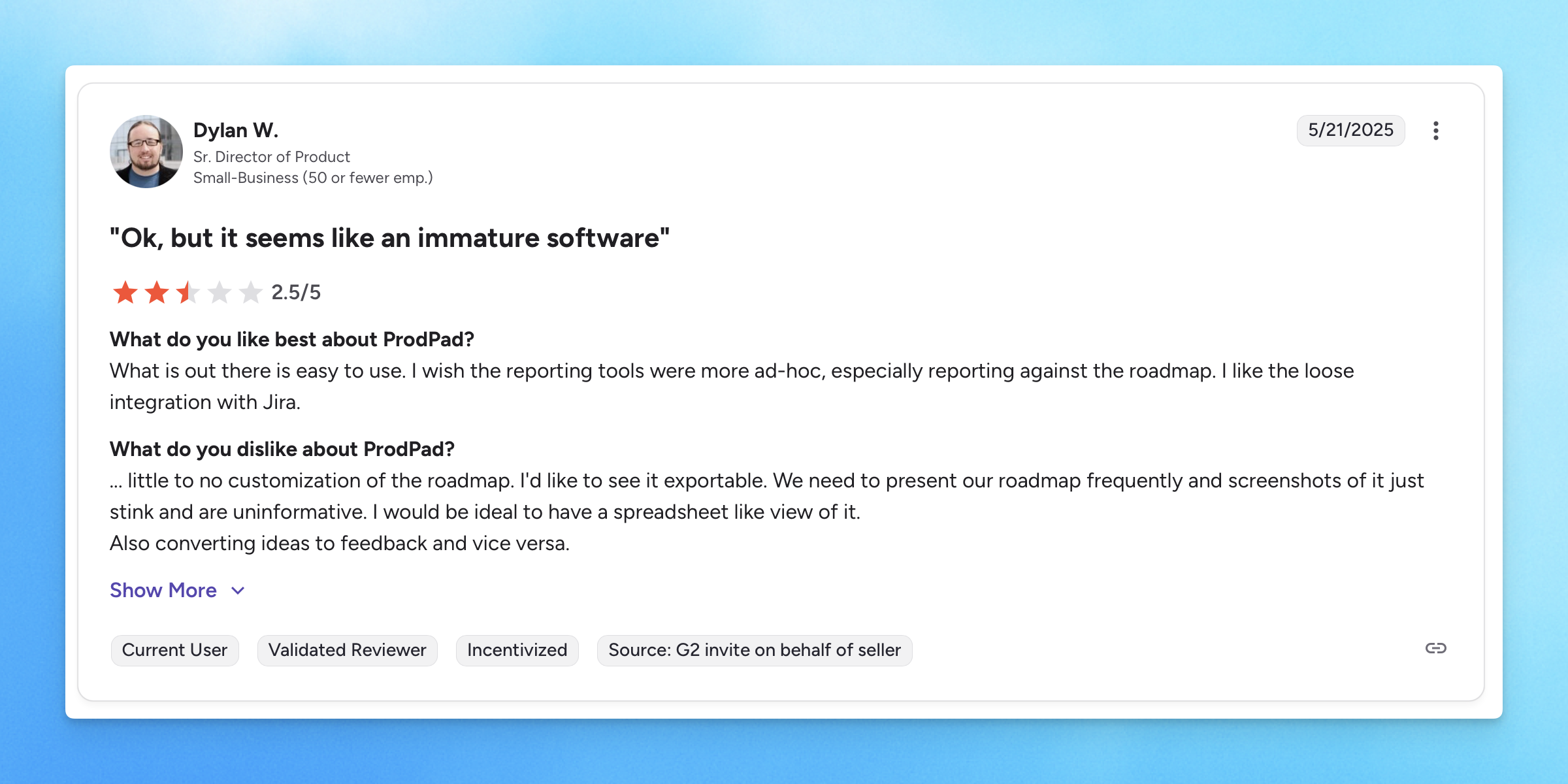
3. The interface shows its age. ProdPad launched in 2012. Reviews consistently mention "papercut issues" - small UX friction points that add up1. The title field doesn't auto-focus when adding feedback. Navigation between modules feels disconnected. It works, but it's not pleasant to use daily.
4. Now-Next-Later is the only roadmap format. ProdPad invented this framework, and the product is built around it. If your stakeholders need timeline views, Gantt-style roadmaps, or date-based planning, ProdPad will fight you. The philosophy is baked into the product - you can't opt out.
5. No knowledge base or forms. If you need a customer-facing help center or want to run surveys alongside your feedback boards, ProdPad doesn't have those modules. You'll need additional tools.
6. Reliability concerns. Multiple reviews mention ideas disappearing and reappearing, and the app reporting itself as offline when it isn't2. For a tool that's supposed to be your canonical product backlog, intermittent data issues are a real problem.
The 10 Best ProdPad Alternatives
1. FeatureOS (Best Overall)

I built FeatureOS, so you should know that upfront. But the reason it tops this list is simple: it's the only tool here that covers feedback, roadmaps, changelog, knowledge base, and forms in a single product - at a fraction of what ProdPad charges for just two of those.
ProdPad makes you buy modules separately. FeatureOS includes everything on every paid plan. There's no "Roadmaps Advanced" upsell. No "Feedback Essentials" tier. You get the full platform from day one.
The feedback boards support public and private use cases with voting, comments, and status updates. What saves real time is the AI-powered duplicate detection and auto-categorization running in the background. When you're handling hundreds of requests a month, not having to manually merge and tag everything adds up fast.
The roadmap supports multiple views - list, kanban, and timeline - so you're not locked into a single philosophy. Your PM can use a lean Now-Next-Later approach while your CEO gets the timeline view they need for board meetings. Same data, different lens.
The changelog is where ProdPad's gap becomes FeatureOS's strength. Scheduled publishing, email notifications, in-app widgets, and reaction tracking mean you can actually close the loop with customers. Ship a feature someone asked for, and they know about it. That's how the feedback lifecycle should work.
Then there's the knowledge base with multilingual support in 21+ languages, custom forms for NPS, CSAT, and bug reports, and in-app widgets for contextual feedback collection. None of this exists in ProdPad at any price.
What you get:
- Public and private feedback boards with AI duplicate detection and auto-categorization
- Multiple roadmaps with list, kanban, and timeline views
- Changelog with scheduled publishing, email notifications, and in-app widgets
- Knowledge base with multilingual support (21+ languages) and SEO controls
- Custom forms for surveys, NPS, CSAT, and bug reports
- In-app widgets for contextual feedback collection
- Native integrations with Jira, Linear, Slack, Intercom, Salesforce, and more
- Custom domain and white-labeling on all plans
Pricing: Paid plans start at $60/month for 5 seats with a 30-day free trial. No per-module pricing. No tracked-user limits. Every plan includes feedback boards, roadmaps, changelog, knowledge base, widgets, and forms. If you're coming from ProdPad, we handle the migration for you.
The math: A 5-person team on FeatureOS pays $60/month for everything. The same team on ProdPad pays $580/month (annual billing) for roadmaps, ideas, and feedback - without changelog, knowledge base, or forms. That's nearly a 10x difference.
Where it falls short: FeatureOS doesn't have ProdPad's OKR management or portfolio-level product management features. If you manage 20+ products with formal objective hierarchies, ProdPad or Aha! are better suited for that. For most product teams under 50 people, those features are overhead you don't need.
2. Canny
Canny is probably the first name that comes up when teams search for feedback tools. Polished product, clean UI, and the voting boards work exactly the way you'd expect.
Their Autopilot feature connects to Intercom and Zendesk and automatically pulls feedback in without manual work. For support-heavy teams, that saves real hours. AI deduplication and smart replies are included on every plan, which is a nice touch.
Here's the catch: Canny uses a tracked-user pricing model. Every person who submits feedback, votes, or comments counts toward your bill. The free plan caps at 25 tracked users. This creates an uncomfortable incentive - the more your customers engage with your feedback board, the more you pay. For growing products, the math turns against you fast.
What you get:
- Public and custom-access feedback boards with voting
- Autopilot for automatic feedback capture from support tools
- AI deduplication and smart replies on all plans
- Customer segmentation by plan type and lifecycle stage
- Roadmap and changelog modules
- CRM integrations with HubSpot and Salesforce
Pricing: Free plan with 25 tracked users. Core from $19/month. Pro from $79/month. Business is custom. All billed yearly.
Where it falls short: Tracked-user pricing punishes growth. One roadmap on lower tiers. No knowledge base. No forms. No in-app widgets on lower plans. For the same budget as Canny Pro, FeatureOS gives you quite a bit more - including features Canny doesn't offer at any tier. We have a detailed FeatureOS vs Canny comparison and a deep dive on Canny's pricing model.
3. Productboard

Productboard sits in a different category from most tools on this list. It's less "feedback tool" and more "product management platform that happens to include feedback." If you think in terms of objectives, scoring matrices, and strategic alignment, Productboard speaks your language.
The insights repository pulls feedback from various sources and links them to features and objectives. On the Pro plan, you can build custom scoring models that factor in strategic fit, customer demand, and effort. That's powerful if you need data-driven prioritization beyond simple vote counts.
The friction is real, though. Productboard is complex. Smaller teams often spend more time configuring the tool than actually using the insights. And the per-maker pricing adds up - at $75/maker/month on Pro, a 5-person product team pays $375/month before a single piece of feedback comes in.
What you get:
- Insights repository with multi-source feedback aggregation
- Custom scoring and prioritization frameworks
- Objective linking and strategic alignment
- Customer segmentation and feedback weighting
- Native Salesforce and CRM integrations
- Productboard Spark (AI, sold separately)
Pricing: Productboard Spark starts at $15/maker/month (annual) or $19/maker/month (monthly), with 250 AI credits per maker included. Legacy Platform plans run Essentials at $25/maker/month and Pro at $75/maker/month. Enterprise is custom.
Where it falls short: The 50-feedback-note limit on the free tier is basically unusable. No changelog. No knowledge base. No forms. Productboard Spark (AI) is a separate product with its own pricing. The learning curve is steep for teams under 20 people. See our Productboard pricing breakdown for the full cost picture.
4. Aha!
Aha! is the enterprise heavyweight. If your organization manages a portfolio of products with formal strategy-to-execution workflows, Aha! is probably the most complete suite on the market.
The product spans roadmaps, ideas (feedback portal), discovery (user research), whiteboards, engineering delivery, knowledge, and team collaboration. Each is a separately priced module. The strategy-to-execution linking - goals to features to releases - is legitimately the strongest I've seen. SAFe and agile framework support is built in through Aha! Develop.
The cost, though. Aha! Roadmaps starts at $59/user/month (which includes Ideas Essentials, Whiteboards Essentials, and Knowledge Essentials). Add Discovery ($39) and Develop ($9) and you're over $100/user/month. A 5-person team on Roadmaps alone: $295/month. That adds up fast.
What you get:
- Full product portfolio management
- Strategy-to-execution linking (goals to features to releases)
- Feedback portal via Aha! Ideas
- Whiteboard collaboration
- Engineering delivery management (Aha! Develop)
- Knowledge base (Aha! Knowledge, $18/user/month)
- SAFe and agile framework support
Pricing: Roadmaps from $59/user/month. Ideas from $39/user/month. Develop from $9/user/month. Knowledge from $18/user/month. No free plan. 30-day trial.
Where it falls short: Most expensive option on this list by a wide margin. Overwhelming for teams under 30 people. Steep onboarding curve. Per-user pricing across every module creates brutal cost scaling. If you don't need formal portfolio management, you're paying enterprise prices for features you'll never touch.
5. Featurebase

Featurebase has been moving fast. They've built a platform that combines customer support (live chat, help center) with product feedback (boards, roadmaps, surveys) under one roof.
Their AI agent, Fibi, handles live chat support and can deflect tickets using your help center articles. The startup program offers 86% off the Professional plan for companies under 2 years old with fewer than 6 employees - a solid deal if you qualify.
The per-seat pricing on higher tiers gets expensive at scale, though. And the AI resolution pricing ($0.29 per resolution) creates unpredictable costs when support volume spikes.
What you get:
- Feedback boards with public voting and roadmaps
- Live chat with AI agent (Fibi) on Growth+
- Help center with 50 articles (free) or unlimited (paid)
- Surveys for NPS, CSAT, and custom research
- Automations, SLA management, and user segmentation on Professional
- Generous startup program (86% off)
Pricing: Free plan available. Growth at $29/seat/month. Professional at $59/seat/month. Enterprise at $99/seat/month. AI resolutions at $0.29 each.
Where it falls short: Per-seat pricing makes it expensive for larger teams. AI resolution metering creates unpredictable costs. Roadmap features aren't as sophisticated as ProdPad or Aha!. The product tries to be both a support tool and a feedback tool, which means neither function goes as deep as dedicated alternatives in each category.
6. Rapidr
Rapidr takes a different approach to pricing: flat team-based tiers instead of per-seat charges. The Startup plan covers 5 team members at $49/month. The Business plan covers 50 members at $199/month with SSO and CRM integrations included.
The platform covers feedback boards, a public roadmap, changelog, and embeddable widgets. It doesn't try to be a full product management suite, and that's actually its appeal. If you want a clean feedback-to-roadmap workflow without the overhead, Rapidr delivers.
What you get:
- Feedback boards with public voting
- Public product roadmap
- Changelog with in-app widgets
- Embeddable widgets for in-app feedback collection
- SSO on Business plan ($199/month)
- White-label on Enterprise
Pricing: Startup at $49/month (5 team members). Business at $199/month (50 members). Enterprise is custom. 14-day free trial.
Where it falls short: No free plan. Startup plan caps at 5 members, so you hit the $199 tier quickly. Limited AI tooling compared to Canny or Featurebase. No knowledge base. Analytics and user segmentation only on Business tier. The jump from $49 to $199 is steep for growing teams.
7. Nolt
Nolt has a pricing model I appreciate: you pay per board, not per user. $39/month gets one board. $89/month gets five. Every team member and every end user gets unlimited access at no extra cost.
The product itself is simple. Feedback boards with voting, a roadmap view, proxy voting (so your support team can submit on behalf of customers), custom statuses, and basic duplicate detection. It integrates with Slack, Intercom, Jira, Linear, and a few others.
Nolt works best when you need one or two focused feedback boards and nothing else. There's no CRM integration, no revenue-based prioritization, and no changelog. Collecting feedback without being able to close the loop means you're running a suggestion box, not a feedback system.
What you get:
- Feedback boards with voting and proxy voting
- Roadmap view
- Custom statuses and basic duplicate detection
- Integrations with Slack, Intercom, Jira, and Linear
- Per-board pricing (not per-user)
Pricing: Essential at $39/month (1 board). Pro at $89/month (5 boards). Enterprise is custom.
Where it falls short: No changelog. No knowledge base. No forms or surveys. No CRM integration. No revenue-based prioritization. The per-board model gets expensive if you manage multiple products. For a tool that only does feedback boards, the price is hard to justify against options that give you the full loop.
8. UserVoice
UserVoice is the oldest tool on this list. They've been doing feedback management since before most of these products existed, and they built specifically for large enterprises with complex internal governance.
If your company has formal product review committees, role-based approval workflows, and strict compliance requirements, UserVoice was designed for that. It includes structured internal review workflows, enterprise security controls, and branded feedback portals. The key differentiator is unlimited users at a flat annual price - no per-seat charges means large organizations with hundreds of stakeholders can give everyone access without worrying about the bill.
What you get:
- Enterprise feedback portals (public and private)
- Structured internal review workflows
- Customer segmentation with CRM data (Salesforce, Zendesk)
- AI-assisted feedback summaries
- Built-in knowledge base for support deflection
- Enterprise security and compliance (SOC 2, GDPR)
- Unlimited users
Pricing: Starts at $16,000/year. No free plan. No self-serve option. Everything goes through sales.
Where it falls short: The $16K/year starting price is prohibitive for anyone outside enterprise budgets. The interface hasn't aged well. Setup takes significant time and internal resources. Roadmapping features are limited compared to ProdPad or Aha!. Most teams that evaluate UserVoice end up realizing they can get 80% of the value from a tool like FeatureOS at 5% of the cost.
9. Pendo
Pendo isn't a direct ProdPad replacement - it's a product analytics and in-app engagement platform that includes feedback collection on its highest tier. I'm including it because teams outgrowing ProdPad sometimes consider Pendo as part of their next stack.
Pendo's strength is behavioral analytics. User session tracking, funnel analysis, in-app guides, and onboarding flows. None of this exists in ProdPad. If your priority is understanding how users behave inside your product (not just what they ask for), Pendo fills a completely different gap.
The feedback module ("Listen") is locked behind the Ultimate plan - Pendo's most expensive tier with custom pricing that typically starts at $20K+/year for mid-market companies. So while Pendo complements a feedback tool, it doesn't replace one.
What you get:
- Product analytics (user behavior, funnels, path analysis)
- In-app guides and onboarding flows
- Session replay (Core+ plans)
- NPS surveys embedded in-app
- Feedback collection ("Listen") on Ultimate plan only
- Enterprise security (SOC 2, GDPR, HIPAA)
Pricing: Free plan with 500 MAU cap. Base, Core, and Ultimate plans are custom-priced based on MAUs.
Where it falls short: Feedback collection is locked behind the most expensive tier. Not a roadmap or strategy tool. Requires engineering work to instrument. The free plan's 500-MAU limit is only useful for very early-stage products. Pendo complements FeatureOS - it doesn't replace it.
10. Frill
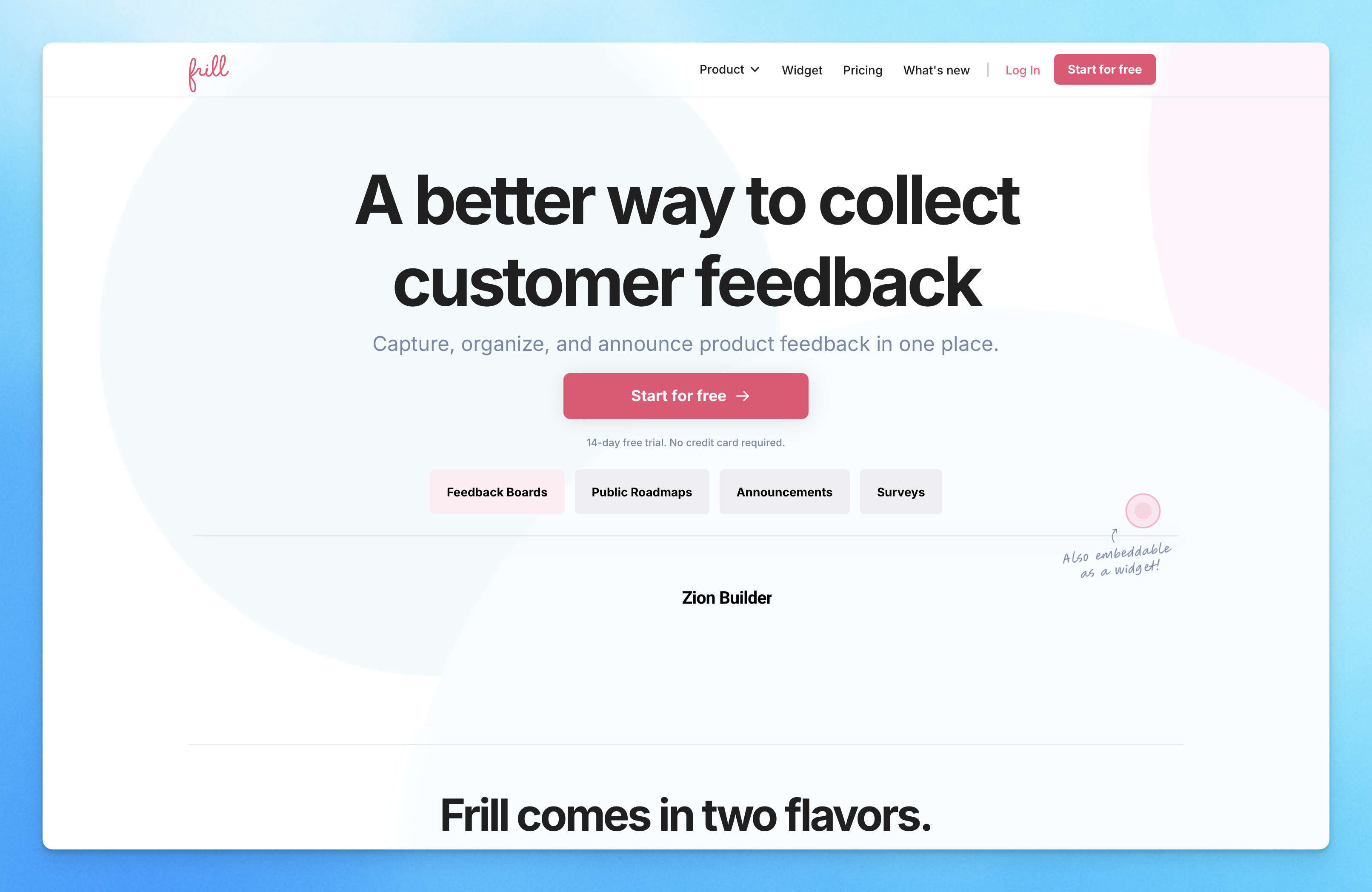
Frill rounds out this list as the lightweight option. It covers feedback boards, a roadmap view, a changelog, and surveys in a clean, simple package. Setup takes about ten minutes.
The standout is unlimited teammates at every tier. Where ProdPad, Productboard, and Aha! charge per seat, Frill lets everyone on your team in at no extra cost. For agencies and companies with many stakeholders who need read/write access, that's a real differentiator.
The trade-off is depth. There's no customer segmentation. No CRM integration. No automated feedback capture. Prioritization is manual. That works fine at 20 requests a month. At 200, you'll want automated deduplication and categorization - which is where FeatureOS picks up where Frill leaves off.
What you get:
- Feedback boards with public voting
- Roadmap view
- Changelog
- Built-in surveys (NPS, CSAT, custom)
- Unlimited teammates on all plans
- White-label on Growth ($149/month)
Pricing: Startup at $25/month (50 ideas, 1 survey). Business at $49/month (unlimited ideas). Growth at $149/month (all add-ons included). Enterprise from $349/month. No free plan. 14-day trial.
Where it falls short: Startup plan caps at 50 ideas - that's extremely limiting. No knowledge base. Limited integrations. No AI tooling. Privacy features are a paid add-on on lower tiers. Not the right fit if you need automated feedback processing or data-driven prioritization.
ProdPad Alternatives Comparison Table
| Tool | Starting Price | Free Plan | Changelog | Knowledge Base | AI Features | Best For |
|---|---|---|---|---|---|---|
| FeatureOS | $60/mo | 30-day trial | Yes | Yes | Yes | All-in-one feedback to changelog |
| Canny | $19/mo | Yes (25 users) | Yes | No | Yes | Lean feedback-first teams |
| Productboard | $25/maker/mo | Limited | No | No | Separate product | PM-heavy orgs with scoring needs |
| Aha! | $59/user/mo | No | No | $18/user/mo add-on | Limited | Enterprise product portfolios |
| Featurebase | $29/seat/mo | Yes | Yes | Yes (help center) | Yes | Startups needing support + feedback |
| Rapidr | $49/mo | No | Yes | No | Limited | Budget-conscious flat-rate teams |
| Nolt | $39/mo | No | No | No | No | Simple per-board pricing |
| UserVoice | $16K/year | No | No | Yes | Yes | Large enterprises |
| Pendo | Custom | Yes (500 MAU) | No | No | Yes | Analytics-first product teams |
| Frill | $25/mo | No | Yes | No | No | Small teams, unlimited seats |
| ProdPad | $116/editor/mo (all modules) | No | No | No | Yes (CoPilot) | PM-focused orgs, lean roadmaps |
How to Pick the Right ProdPad Alternative
Here's how I'd think about it.
For most teams, FeatureOS is the best starting point. You get feedback boards, roadmaps, changelog, knowledge base, and forms in one tool. No per-module pricing. No tracked-user limits. A 30-day free trial to test everything. And the migration from ProdPad is handled for you.
That said, there are scenarios where a different tool makes more sense:
You're a large enterprise with formal product governance and a six-figure tool budget. Look at Aha! or UserVoice. They're built for organizations with complex approval workflows and portfolio management needs that smaller tools don't address.
You primarily want product analytics and in-app engagement, not just feedback collection. Look at Pendo. But you'll still need a feedback tool alongside it - Pendo's feedback module is locked behind their most expensive tier.
You're an early-stage startup (under 2 years, under 6 people) and want the cheapest possible option. Look at Featurebase's startup program (86% off) or FeatureOS's 30-day free trial to test before committing. Both offer startup-friendly pricing.
Your feedback comes primarily through support conversations in Intercom or Zendesk. Look at Canny's Autopilot for automatic feedback capture from those tools. Though keep in mind the tracked-user pricing will grow with your customer base.
You just need a simple voting board and nothing else. Look at Nolt for per-board pricing or Frill for unlimited teammates.
The worst thing you can do is keep paying for a tool that charges you $580/month for three modules when you can get more functionality for $60. Start with what you need today. But if I had to pick one tool to replace ProdPad, it's FeatureOS.
Ready to switch? Start your free trial or see how we compare to ProdPad.
Related Reading
- Top 12 Canny.io Alternatives for SaaS Products - If you're also evaluating Canny alongside ProdPad
- 9 Best Customer Feedback Management Tools in 2026 - A broader look at the feedback tool landscape
- ProdPad Pricing: What It Really Costs - Our detailed head-to-head comparison with ProdPad
Footnotes
-
Based on user reviews aggregated from G2 and Capterra. Multiple reviewers cite UX friction including non-auto-focusing input fields and disconnected navigation. ↩
-
Reported across user reviews on Capterra and TrustRadius. Specific complaints include intermittent offline status and temporary data visibility issues. ↩
Frequently Asked Questions
Everything you need to know
ProdPad is a product management platform that helps product teams manage lean roadmaps, collect and prioritize ideas, and gather customer feedback. It is built around the Now-Next-Later roadmap methodology and includes modules for OKRs, portfolio management, and an AI CoPilot. ProdPad is primarily designed for product managers who want to connect strategy to execution using outcome-based roadmapping.
ProdPad uses modular, per-editor pricing. Each module (Roadmaps, Ideas, Feedback) is billed separately. Roadmaps Essentials starts at $30/editor/month, Roadmaps Advanced at $55/editor/month. Ideas and Feedback modules range from $30 to $45/editor/month each. A single editor using all three modules on the Advanced tier pays around $145/month. A 5-person team using all modules can expect to pay $725/month or more.
No. ProdPad offers a free trial (starting at 7 days, extendable to 30+ days by completing onboarding tasks), but there is no permanent free plan. Contributors and Reviewers get free access, but editors who manage the platform must be on a paid plan.
FeatureOS is the best ProdPad alternative for most product teams. It includes feedback boards, roadmaps, changelog, knowledge base, and custom forms in a single platform starting at $60/month for 5 seats, with a 30-day free trial. Unlike ProdPad, FeatureOS does not use per-module pricing, includes a native changelog for closing the feedback loop, and offers a knowledge base and forms at no extra cost.
No. ProdPad does not include a native changelog or release notes feature. Teams using ProdPad need a separate tool to notify customers about shipped features and product updates. This means there is no built-in way to close the feedback loop within ProdPad itself.
Yes. FeatureOS offers assisted migration from ProdPad. The FeatureOS team handles the data transfer so your feedback, ideas, and roadmap items are preserved. You can start the process at featureos.com/switch or contact the FeatureOS support team directly.
ProdPad can work for small product teams, but the modular pricing model makes it expensive for startups. A solo founder using all three modules pays around $78-145/month, and there is no free plan. Alternatives like FeatureOS (30-day free trial, paid plans from $60/month) and Canny (free plan with 25 tracked users) offer more startup-friendly pricing.
ProdPad does not include a changelog or release notes feature, a customer-facing knowledge base, custom forms or surveys, or flexible roadmap views beyond the Now-Next-Later format. Most modern alternatives include at least some of these features as standard. ProdPad's strengths are in lean roadmap methodology, OKR management, and idea prioritization workflows.